Untitled work
Description
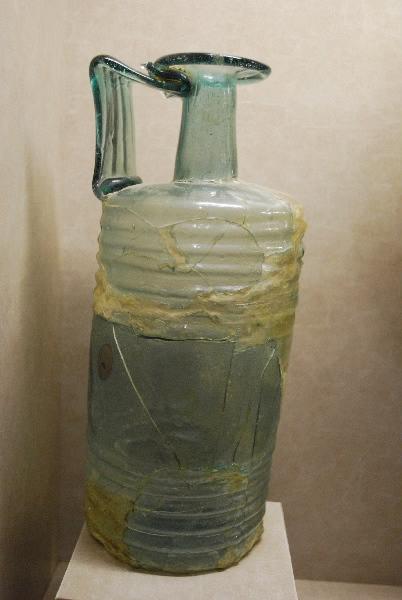
Barillet en verre soufflé dans un moule, blanc, légèrement verdâtre, forme Morin-Jean 132 et Isings 89. ; 'Le barillet (a), en verre moulé, présente une lèvre arrondie ourlée plate; goulot cylindrique, comme la panse décorée à ses deux extrémités de cercles en relief imitant les cerceaux du tonneau; anse larges à nervures; fond légèrement bombé portant des lettres FRON (forme Morin-Jean 132 et Isings 89). [...] Les bouteilles, très souvent moulées, furent l'objet d'une évolution qui donna naissance aux barillet, invention typiquement gauloise comme le tonneau qu'elle essaie d'imiter. Les barillets, dont la forme naquit peut-être en Bourgogne (Sennequier, 1977, XXVIII, fasc. 3-4, ch. VI, pp. 255-262) furent exportés aussi bien sur tout le territoire de la Gaule Belgique qu'en Germanie, et des sites bourguignons comme d'Alésia et Malain en ont fourni plusieurs fragments. Le verrier Frontinus apposa sa signature sur un nombre considérable de barillets comme nous le montre Autun (Chassaing, 1961, XII, fasc. 1, pp. 7-33). La seule région normande en a livré de nombreux exemplaires (Sennequier, 1985, pp. 169-182).' Autun, Augustodunum, 1987, pp. 143-151, n° 235-252 dont p. 147, n° 244 ; 'Vase en forme de barillet avec imitation du cerclage en relief. Goulot à lèvres plates. Anse large ornée de 5 godrons. Diam. : 0.06; H. : 0.25; Larg. de l'anse : 0.045. Un vase semblable figure dans les fouilles de l'Abbé Cochet. La Petite Verrière, polyande du Bois Saint-Jean, mai 1878; dans une sépulture de famille comprenant trois cercueils de plomb, dont un d'enfant (cf. B.15).' Fiche Inventaire Bulliot ; 'Ce barillet possède une panse cylindrique à décor moulé de six cerceaux dans la partie inférieure et six autres dans la partie supérieure. Le goulot et la lèvre plate ourlée vers l'intérieur sont soufflés à l'air libre tandis que l'anse à nervures multiples est en verre étiré. Sur le fond un peu bombé, on peut lire l'inscription FRON du verrier FRONTINUS. IV° siècle?' Vitrum, 1990, p. 32, n° 13
About this work
The artwork titled "This artwork", attributed to FRONTINUS (atelier, verrier), is preserved at musée Rolin. Referenced in the Joconde database, this work contributes to the national artistic heritage preserved in labeled museums.
Technique and Materials
This work belongs to the field: archéologie, verrerie, gallo-romain. It was created using the following materials and techniques: verre, coloré, soufflé, moulage. Its period of creation is identified as: 4th Century.
The Conserving Museum
musée Rolin preserves this work in its collections. As a « Musée de France » labeled museum, the institution is committed to preserving and showcasing the pieces entrusted to it.
Data sources
The information about this work comes from the Joconde database of the Ministry of Culture, published on data.culture.gouv.fr under the Open License v2.0 (Etalab).
About this artwork
Il s'agit d'une oeuvre en verre, coloré, soufflé, moulage. L'oeuvre présente les dimensions suivantes : Hauteur en cm 25.02 ; Diamètre en cm 6.00. Cette réalisation date de la 4e siècle.
Creation context
FRONTINUS (atelier, verrier) crée à une époque où la 4e siècle transforme en profondeur le paysage artistique. Le musée Rolin, qui abrite cette œuvre, offre au visiteur la possibilité de mesurer l'influence du contexte historique et culturel sur la démarche de l'artiste. Les circonstances de la création éclairent le sens et la portée de cette pièce remarquable.
See also
Technique
Author
Related pages
Frequently Asked Questions
Everything you need to know
The work « Untitled work » is held at musée Rolin, an institution labeled as a « Musée de France ». This label guarantees the quality of collection preservation and accessibility to the public.
This artwork is attributed to FRONTINUS (atelier, verrier) according to the Joconde database of the Ministry of Culture. Check the artist's profile on DellArte to discover their background, other works, and museums that house their creations.
Data comes from the Joconde database of the Ministry of Culture (data.culture.gouv.fr), distributed under Open License v2.0 (Etalab). The records are provided by the museums and validated by the French Museum Service.
The work is part of the collections of a « Musée de France »-labelled museum. Contact the hosting museum to verify if the work is currently on display or held in reserve. Opening hours and admission fees are available on the museum's official website.
Image usage rights depend on the work, the artist, and the museum. If the author died more than 70 years ago, the work is in the public domain in France. Text data (title, technique, dimensions) are under Open License and freely reusable.
The work's record contains information from the Joconde database: title, author, technique and materials used, dimensions, creation period, artistic domain, inventory number, hosting museum, and when available, a digital image.
Use the DellArte contact page to report errors. Since data comes from the Joconde database, major corrections (attribution, dating, technique) should be reported to the Ministry of Culture via data.culture.gouv.fr.
The Joconde database lists over 700,000 works. Use the search bar to find works by the same artist, technique, or period. Each museum entry provides access to its entire digitized collection.
The image resolution depends on the museum's digitization program. Some museums offer high-resolution images through their own digital platforms. The image displayed on DellArte comes from the Joconde database at its dissemination resolution.
Museum shops often sell reproductions of their main works (postcards, posters, art books). For public domain works, services like RMN-Grand Palais (photo.rmn.fr) offer professional photographic reproductions.