Untitled work
Description
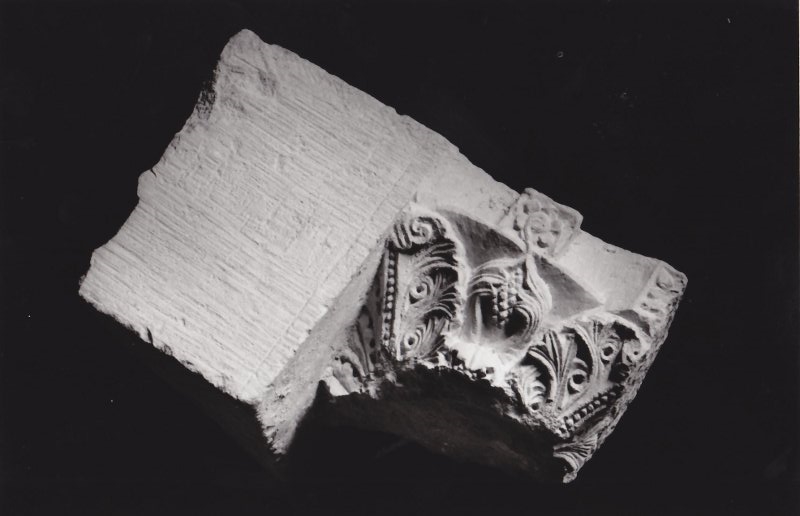
Seul le décor d'une des deux faces sculptées reste encore visible. Sous chaque angle de l'abaque convexe se développe une feuille grasse dont la tige se compose de perles alignées. Entre ses folioles nervurées d'autres feuilles s'enroulent autour de trous de trépan. Dans l'axe de symétrie vertical, deux feuilles se referment sur un fruit d'arum. Leur fine extrémité se dresse afin de ponctuer la fleur centrale du dé de l'abaque. Plus bas, une feuille presque lisse se replie sur elle même tandis que les folioles latérales cernent un trou de trépan. Le fruit d'arum ou pomme de pin utilisé comme terminaison de feuille d'acanthe est un motif présent sur certains chapiteaux de la nef. Il figure à l'identique sur un petit chapiteau de pilastre doté du même décor de perles et de fleurs sur l'abaque. Un tel ornement fut, si l'on en croit la gravure de Dom Plancher, souvent reproduit aux portails occidentaux de Saint-Jean-de-Réome exécutés lors de la seconde campagne de restauration, sous l'abbatiat de Pierre (1139-1179). Notre chapiteau provient très vraisemblablement de l'atelier qui se chargea du décor de ces portails et peut être daté du troisième quart du XIIe siècle mais il n'appartenait certainement pas aux portails car ses dimensions sont inférieures à celles d'un chapiteau conservé et identifié grâce à la gravure de Dom Plancher. Il devait probablement surmonter le piédroit d'une porte ou d'une ouverture : il conserve encore sa queue, celle-ci forme un bloc quadrangulaire à dextre du chapiteau. (Frédérique Bouvard). (JANNET Monique et JOUBERT Fabienne (dir.), Sculpture médiévale en Bourgogne - Collection lapidaire du Musée archéologique de Dijon, EUD, 2000)
Subject depicted
représentation végétale (feuille, fruit)
About this work
The artwork titled "This artwork" is preserved at musée archéologique. This piece is listed in the Joconde database of the Ministry of Culture, which catalogues the works held in French museums.
Technique and Materials
This work belongs to the field: archéologie, architecture, sculpture, médiéval. It was created using the following materials and techniques: calcaire (taillé). Its period of creation is identified as: 3rd quarter 12th Century.
The Conserving Museum
"This artwork" is preserved at musée archéologique, an institution bearing the « Musée de France » label. This label ensures that the collections are managed rigorously in terms of conservation, inventory, and public accessibility.
Data sources
The information about this work comes from the Joconde database of the Ministry of Culture, published on data.culture.gouv.fr under the Open License v2.0 (Etalab).
About this artwork
L'oeuvre a été exécutée en calcaire (taillé). Dimensions de l'oeuvre : Hauteur en cm 31 ; Largeur en cm 50,5 ; Profondeur en cm 29,5. Le motif représenté : représentation végétale (feuille, fruit). Cette réalisation date de la 3e quart 12e siècle.
Creation context
La 3e quart 12e siècle fournit à le cadre propice pour imaginer . Cette œuvre, aujourd'hui trésor du musée archéologique, est l'aboutissement d'un échange fécond entre le créateur et les mouvements de pensée de son temps. Le contexte intellectuel et artistique se lit dans chaque choix formel de la composition.
See also
Technique
Related pages
Frequently Asked Questions
Everything you need to know
The work « Untitled work » is held at musée archéologique, an institution labeled as a « Musée de France ». This label guarantees the quality of collection preservation and accessibility to the public.
This artwork is attributed to according to the Joconde database of the Ministry of Culture. Check the artist's profile on DellArte to discover their background, other works, and museums that house their creations.
Data comes from the Joconde database of the Ministry of Culture (data.culture.gouv.fr), distributed under Open License v2.0 (Etalab). The records are provided by the museums and validated by the French Museum Service.
The work is part of the collections of a « Musée de France »-labelled museum. Contact the hosting museum to verify if the work is currently on display or held in reserve. Opening hours and admission fees are available on the museum's official website.
Image usage rights depend on the work, the artist, and the museum. If the author died more than 70 years ago, the work is in the public domain in France. Text data (title, technique, dimensions) are under Open License and freely reusable.
The work's record contains information from the Joconde database: title, author, technique and materials used, dimensions, creation period, artistic domain, inventory number, hosting museum, and when available, a digital image.
Use the DellArte contact page to report errors. Since data comes from the Joconde database, major corrections (attribution, dating, technique) should be reported to the Ministry of Culture via data.culture.gouv.fr.
The Joconde database lists over 700,000 works. Use the search bar to find works by the same artist, technique, or period. Each museum entry provides access to its entire digitized collection.
The image resolution depends on the museum's digitization program. Some museums offer high-resolution images through their own digital platforms. The image displayed on DellArte comes from the Joconde database at its dissemination resolution.
Museum shops often sell reproductions of their main works (postcards, posters, art books). For public domain works, services like RMN-Grand Palais (photo.rmn.fr) offer professional photographic reproductions.