Untitled work
Description
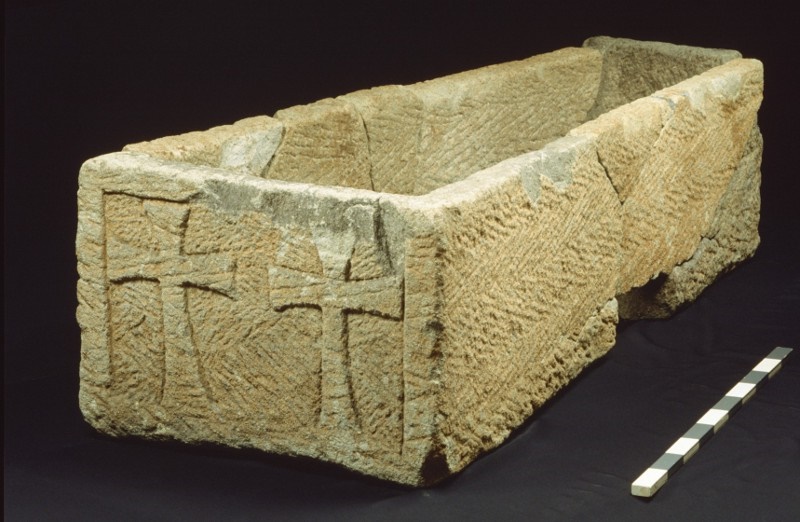
Grès ; L'intérieur montre un fond taillé grossièrement ; les bords conjuguent travail à la pointe et longs enlèvements parallèles. A l'extérieur du panneau de tête, on voit des bandes de réserves en taille douce. Les deux croix sont en relief et un sillon souligne leur contour ainsi que les bandes de réserve. La surface de fond montre des séries de lignes de tailles parallèles créées par la broche. Les parois latérales sont plus régulièrement taillées en chevrons ménageant à la base une réserve de taille plus sommaire. Le sarcophage de Longvic appartient au type des sarcophages connu pour l'époque mérovingienne, soit par les traces de taille, soit par la présence de plusieurs croix sur le panneau de tête (exemple du sarcophage 110 du musée Carnavalet). Il peut également être rapproché des sarcophages ainsi décorés découverts à Saint-Philibert de Tournus ou, plus récemment, à Saint-Clément de Mâcon ou encore à Saint-Symphorien d'Autun. La présence de ce décor le place dans la parenté du groupe nivernais aux croix multiples fréquentes, et daté de la fin du VIe ou du VIIe siècles. Le mobilier retrouvé dans le même horizon de la nécropole, où plus de sept sarcophages seront fouillés dans le même secteur en plusieurs campagnes de sauvetage ou en découvertes fortuites entre 1960 et 1964, a fourni des boucles de bronze, plaques-boucles, épée et scramasaxe, que l'on peut situer dans la seconde moitié du VIe et au VIIe siècle (Christian Sapin). (JANNET Monique et JOUBERT Fabienne (dir.), Sculpture médiévale en Bourgogne - Collection lapidaire du Musée archéologique de Dijon, 2000)
Subject depicted
(croix)
About this work
The artwork titled "This artwork" is preserved at musée archéologique. Referenced in the Joconde database, this work contributes to the national artistic heritage preserved in labeled museums.
Technique and Materials
This work belongs to the field: archéologie, sculpture, croyances - coutumes, médiéval. It was created using the following materials and techniques: grès (taillé). Its period of creation is identified as: 6th Century;7th Century.
The Conserving Museum
"This artwork" is preserved at musée archéologique, an institution bearing the « Musée de France » label. This label ensures that the collections are managed rigorously in terms of conservation, inventory, and public accessibility.
Data sources
The information about this work comes from the Joconde database of the Ministry of Culture, published on data.culture.gouv.fr under the Open License v2.0 (Etalab).
About this artwork
Il s'agit d'une oeuvre en grès (taillé). Les dimensions de l'oeuvre sont : Longueur en cm 208 ; Largeur en cm 78 ; Largeur en cm 52 ; Hauteur en cm 55. Le motif représenté : (croix). L'oeuvre appartient à la 6e siècle;7e siècle.
Creation context
conçoit dans un environnement artistique façonné par la 6e siècle;7e siècle. Cette pièce, conservée au musée archéologique, porte l'empreinte des débats esthétiques et des innovations techniques qui animent alors la scène culturelle. Comprendre ce contexte permet d'apprécier pleinement la portée de l'œuvre.
See also
Technique
Related pages
Frequently Asked Questions
Everything you need to know
The work « Untitled work » is held at musée archéologique, an institution labeled as a « Musée de France ». This label guarantees the quality of collection preservation and accessibility to the public.
This artwork is attributed to according to the Joconde database of the Ministry of Culture. Check the artist's profile on DellArte to discover their background, other works, and museums that house their creations.
Data comes from the Joconde database of the Ministry of Culture (data.culture.gouv.fr), distributed under Open License v2.0 (Etalab). The records are provided by the museums and validated by the French Museum Service.
The work is part of the collections of a « Musée de France »-labelled museum. Contact the hosting museum to verify if the work is currently on display or held in reserve. Opening hours and admission fees are available on the museum's official website.
Image usage rights depend on the work, the artist, and the museum. If the author died more than 70 years ago, the work is in the public domain in France. Text data (title, technique, dimensions) are under Open License and freely reusable.
The work's record contains information from the Joconde database: title, author, technique and materials used, dimensions, creation period, artistic domain, inventory number, hosting museum, and when available, a digital image.
Use the DellArte contact page to report errors. Since data comes from the Joconde database, major corrections (attribution, dating, technique) should be reported to the Ministry of Culture via data.culture.gouv.fr.
The Joconde database lists over 700,000 works. Use the search bar to find works by the same artist, technique, or period. Each museum entry provides access to its entire digitized collection.
The image resolution depends on the museum's digitization program. Some museums offer high-resolution images through their own digital platforms. The image displayed on DellArte comes from the Joconde database at its dissemination resolution.
Museum shops often sell reproductions of their main works (postcards, posters, art books). For public domain works, services like RMN-Grand Palais (photo.rmn.fr) offer professional photographic reproductions.