Untitled work
School : France;Chine
Description
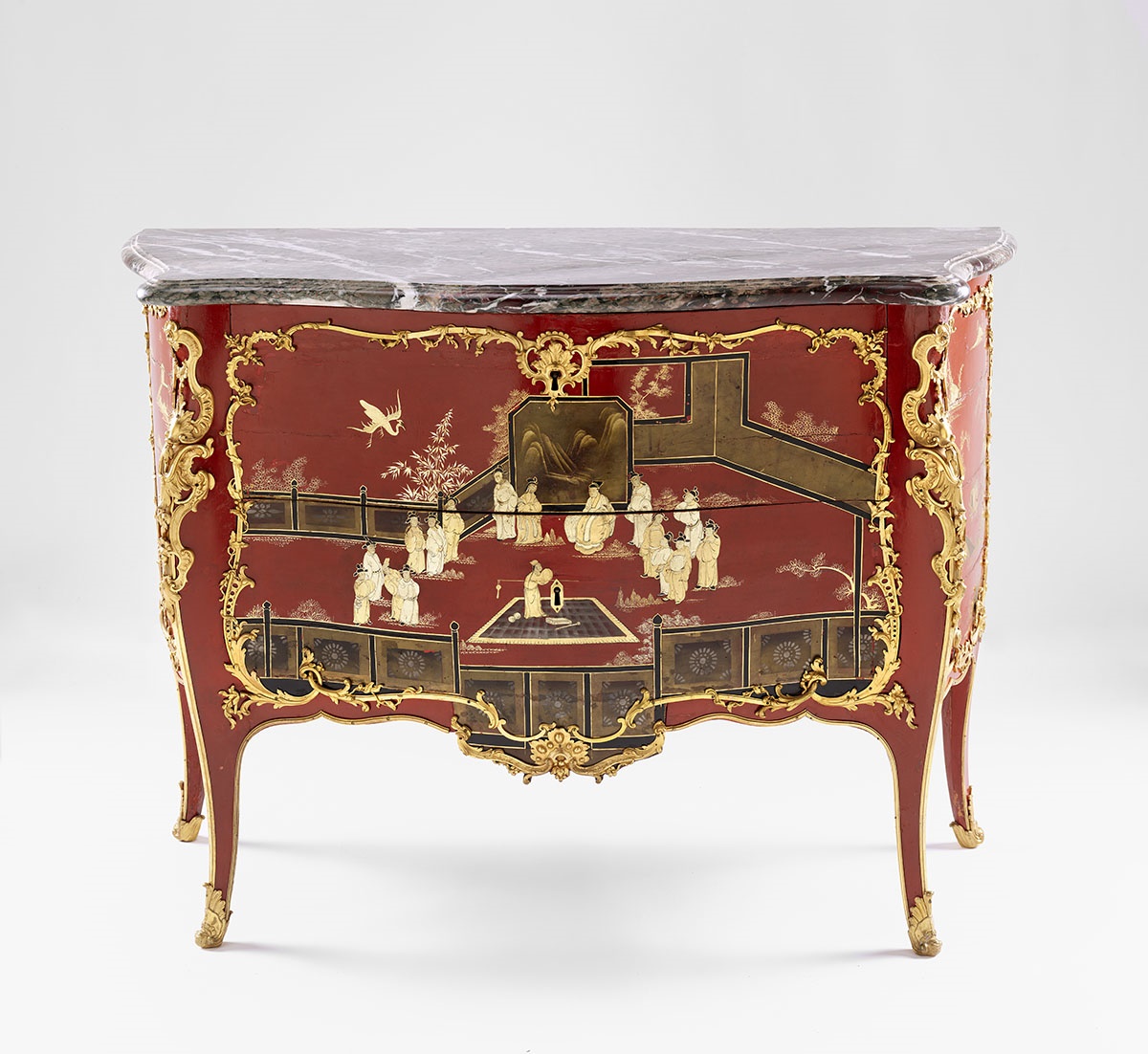
Chêne plaqué, laque de Chine rouge, vernis européen à fond rouge, bronze ciselé et doré, marbre Campan ; Bernard II Van Risen Burgh, dit B.V.R.B. (1700-1760) Commode à décor chinois Chine, dynastie Qing, époque Qianlong (1736-1795), et Paris, vers 1755 Chêne plaqué, laque de Chine rouge, vernis européen à fond rouge, bronze ciselé et doré, marbre Campan Le marchand mercier Thomas-Joachim Hébert (1687-1773) est certainement le premier à faire réaliser des meubles à partir de panneaux de laque venus d’Extrême-Orient. Une spécialité que partage Lazare Duvaux (vers 1703-1758) installé à l’enseigne du Chagrin de Turquie, à Paris. Autour de 1750, il vend quatre commodes ainsi décrites : « plaquée en vernis rouge, à pagodes, garnie partout de bronze doré d’or moulu, avec son marbre de vert campan ». Le modèle peut être rapproché de cette commode exécutée par l’ébéniste Bernard II Van Risen Burg (1700-1760), dont les panneaux de laque rouge de Chine sont recouverts d’un décor en vernis européen. (Catherine Tran, 2023)
Subject depicted
figures (personnage, chinois, costume traditionnel, oiseau, fleur orn.)
About this work
The artwork titled "This artwork", attributed to Van Risen Burgh Bernard II (1705-1766) (ébéniste);anonyme, is preserved at musée des beaux-arts. Referenced in the Joconde database, this work contributes to the national artistic heritage preserved in labeled museums.
Technique and Materials
This work belongs to the field: ébénisterie, arts décoratifs, ameublement, Asie orientale. It was created using the following materials and techniques: chêne (plaqué, laqué, rouge, vernis, or), marbre, bronze (ciselé (métal), doré (métal)). Its period of creation is identified as: 3rd quarter 18th Century;2nd quarter 18th Century.
The Conserving Museum
"This artwork" is preserved at musée des beaux-arts, an institution bearing the « Musée de France » label. This label ensures that the collections are managed rigorously in terms of conservation, inventory, and public accessibility.
Data sources
The information about this work comes from the Joconde database of the Ministry of Culture, published on data.culture.gouv.fr under the Open License v2.0 (Etalab).
About this artwork
Le procédé technique employé est chêne (plaqué, laqué, rouge, vernis, or), marbre, bronze (ciselé (métal), doré (métal)). Dimensions : Dimensions Hauteur : 81 cm ; Largeur : 109 cm ; Profondeur : 48,5 cm ; Hauteur (en cm) 81 ; Largeur (en cm) 109 ; Profondeur (en cm) 48,5 ; Hauteur du marbre (en cm) 3 ; Largeur du marbre (en cm) 114 ; Profondeur maximale du marbre (en cm) 54. Elle figure : figures (personnage, chinois, costume traditionnel, oiseau, fleur orn.). La création de cette oeuvre remonte à la 3e quart 18e siècle;2e quart 18e siècle.
Creation context
émerge du bouillonnement de la 3e quart 18e siècle;2e quart 18e siècle, époque où Van Risen Burgh Bernard II (1705-1766) (ébéniste);anonyme atteint la pleine maturité de son art. Visible au musée des beaux-arts, cette œuvre illustre à quel point le contexte historique nourrit et façonne la création artistique, lui conférant une profondeur qui va bien au-delà de la seule dimension esthétique.
Frequently Asked Questions
Everything you need to know
The work « Untitled work » is held at musée des beaux-arts, an institution labeled as a « Musée de France ». This label guarantees the quality of collection preservation and accessibility to the public.
This artwork is attributed to Van Risen Burgh Bernard II (1705-1766) (ébéniste);anonyme according to the Joconde database of the Ministry of Culture. Check the artist's profile on DellArte to discover their background, other works, and museums that house their creations.
Data comes from the Joconde database of the Ministry of Culture (data.culture.gouv.fr), distributed under Open License v2.0 (Etalab). The records are provided by the museums and validated by the French Museum Service.
The work is part of the collections of a « Musée de France »-labelled museum. Contact the hosting museum to verify if the work is currently on display or held in reserve. Opening hours and admission fees are available on the museum's official website.
Image usage rights depend on the work, the artist, and the museum. If the author died more than 70 years ago, the work is in the public domain in France. Text data (title, technique, dimensions) are under Open License and freely reusable.
The work's record contains information from the Joconde database: title, author, technique and materials used, dimensions, creation period, artistic domain, inventory number, hosting museum, and when available, a digital image.
Use the DellArte contact page to report errors. Since data comes from the Joconde database, major corrections (attribution, dating, technique) should be reported to the Ministry of Culture via data.culture.gouv.fr.
The Joconde database lists over 700,000 works. Use the search bar to find works by the same artist, technique, or period. Each museum entry provides access to its entire digitized collection.
The image resolution depends on the museum's digitization program. Some museums offer high-resolution images through their own digital platforms. The image displayed on DellArte comes from the Joconde database at its dissemination resolution.
Museum shops often sell reproductions of their main works (postcards, posters, art books). For public domain works, services like RMN-Grand Palais (photo.rmn.fr) offer professional photographic reproductions.