Asmodaï (Information spécifique)
School : France
Description
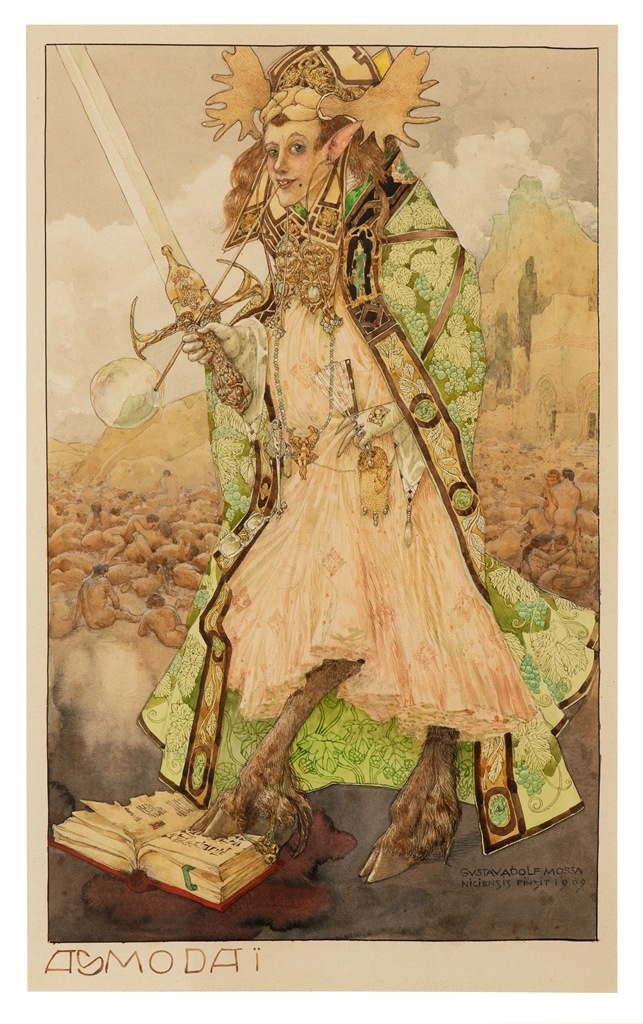
Aquarelle, mine de plomb et encre sur papier ; Autre exemple de l’engouement de Mossa pour l’Art nouveau, cette œuvre manifeste son souci du détail orfévré. Le manche de l’épée que tient Asmodaï, sa ceinture et ses bijoux sont de magnifiques créations inspirées des joailliers des années 1900, tels que Vever ou Gaillard. L’éventail, accessoire phare de l’androgyne satanique, est plutôt japonisant. Assimilé dans la Bible au démon des plaisirs impurs, Asmodaï se tient ici devant une foule se livrant à la débauche. Sa coiffe en cornes de cerf et son épée, symboles éminemment sexuels, contrastent avec les attributs religieux dont il est paré, comme la mitre et la chape, et qu’il profane. (cartel développé, exposition Gustav-Adolf Mossa. Niciensis pinxit, 2022)
Subject depicted
cerf,vêtement liturgique,epée,bouc,vigne
About this work
The artwork titled "Asmodaï (Information spécifique)", attributed to Mossa Gustave-Adolphe (1883-1971), is preserved at musée des beaux-arts Jules Chéret. This piece is listed in the Joconde database of the Ministry of Culture, which catalogues the works held in French museums.
Technique and Materials
This work belongs to the field: dessin. It was created using the following materials and techniques: aquarelle, mine de plomb, encre, papier. Its period of creation is identified as: 1st quarter 20th Century.
The Conserving Museum
musée des beaux-arts Jules Chéret preserves this work in its collections. As a « Musée de France » labeled museum, the institution is committed to preserving and showcasing the pieces entrusted to it.
Data sources
The information about this work comes from the Joconde database of the Ministry of Culture, published on data.gouv.fr under the Open License v2.0 (Etalab).
About this artwork
Asmodaï (Information spécifique), oeuvre de dessin, est due à Mossa Gustave-Adolphe (1883-1971) et conservée au musée des beaux-arts Jules Chéret. Cette pièce est en aquarelle, mine de plomb, encre, papier. Format : Hauteur avec cadre en cm 79 ; Largeur en cm 65.1 ; Hauteur en cm 63 ; Largeur en cm 46,5 ; Hauteur en cm 46 ; Largeur en cm 27.5. Le motif représenté : cerf,vêtement liturgique,epée,bouc,vigne. L'oeuvre appartient à la 1er quart 20e siècle. Précisions sur cette oeuvre : Mossa Gustave-Adolphe : Nice, 1883 ; Nice, 1971.
Creation context
Quand Mossa Gustave-Adolphe (1883-1971) entreprend la réalisation de Asmodaï (Information spécifique), la 1er quart 20e siècle bat son plein et redéfinit les codes de la création. Cette œuvre, aujourd'hui au musée des beaux-arts Jules Chéret, porte la marque indélébile de son époque, témoignant des tensions créatrices et des aspirations qui animent alors les milieux artistiques.
See also
Technique
Domain
Artistic movements
Frequently Asked Questions
Everything you need to know
The work « Asmodaï (Information spécifique) » is held at musée des beaux-arts Jules Chéret, an institution labeled as a « Musée de France ». This label guarantees the quality of collection preservation and accessibility to the public.
This artwork is attributed to Mossa Gustave-Adolphe (1883-1971) according to the Joconde database of the Ministry of Culture. Check the artist's profile on DellArte to discover their background, other works, and museums that house their creations.
Data comes from the Joconde database of the Ministry of Culture (data.gouv.fr), distributed under Open License v2.0 (Etalab). The records are provided by the museums and validated by the French Museum Service.
The work is part of the collections of a « Musée de France »-labelled museum. Contact the hosting museum to verify if the work is currently on display or held in reserve. Opening hours and admission fees are available on the museum's official website.
Image usage rights depend on the work, the artist, and the museum. If the author died more than 70 years ago, the work is in the public domain in France. Text data (title, technique, dimensions) are under Open License and freely reusable.
The work's record contains information from the Joconde database: title, author, technique and materials used, dimensions, creation period, artistic domain, inventory number, hosting museum, and when available, a digital image.
Use the DellArte contact page to report errors. Since data comes from the Joconde database, major corrections (attribution, dating, technique) should be reported to the Ministry of Culture via data.gouv.fr.
The Joconde database lists over 700,000 works. Use the search bar to find works by the same artist, technique, or period. Each museum entry provides access to its entire digitized collection.
The image resolution depends on the museum's digitization program. Some museums offer high-resolution images through their own digital platforms. The image displayed on DellArte comes from the Joconde database at its dissemination resolution.
Museum shops often sell reproductions of their main works (postcards, posters, art books). For public domain works, services like RMN-Grand Palais (photo.rmn.fr) offer professional photographic reproductions.