Untitled work
School : France, Sarreguemines
Description
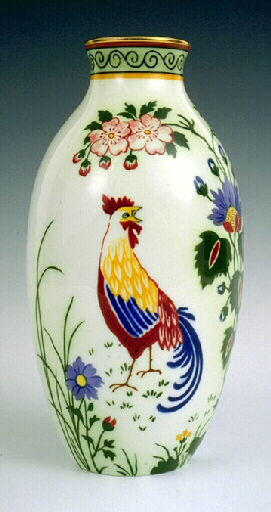
Vase en porcelaine phosphatique à décor peint signé Reitter
Subject depicted
représentation animalière (coq, fleur)
About this work
The artwork titled "This artwork", attributed to REITTER Victor Henri (peintre de porcelaine);Faïencerie de Sarreguemines (fabricant), is preserved at musée de la faïence et des techniques faïencières. Referenced in the Joconde database, this work contributes to the national artistic heritage preserved in labeled museums.
Technique and Materials
This work belongs to the field: céramique. It was created using the following materials and techniques: porcelaine phosphatique, peint au pinceau, emploi d'or. Its period of creation is identified as: 1st quarter 20th Century.
The Conserving Museum
musée de la faïence et des techniques faïencières preserves this work in its collections. As a « Musée de France » labeled museum, the institution is committed to preserving and showcasing the pieces entrusted to it.
Data sources
The information about this work comes from the Joconde database of the Ministry of Culture, published on data.culture.gouv.fr under the Open License v2.0 (Etalab).
About this artwork
Elle est réalisée avec la technique suivante : porcelaine phosphatique, peint au pinceau, emploi d'or. Format : H. en cm 19 ; D. en cm 11. On y reconnaît : représentation animalière (coq, fleur). Cette réalisation date de la 1er quart 20e siècle. Détail à relever : Reitter Victor Henry, né à Sarreguemines en 1859, décédé à Sarreguemines en 1923, à 62 ans. Madame Reitter, née Schwartz Mélanie, à Le Cateau Cambresis (Nord). Victor Reitter a travaillé à la faïencerie de Sarreguemines en qualité de 'Compositeur en céramique d'art.' Le baron Paul de Geiger lui a demandeé de réaliser une trentaine de vases pour l'exposition de Paris (1900?) Parmi ceux là, les trois vases signés par lui même et offert au Musée de Sarreguemines, par son fils, Reitter René Henry Charles né à Sarreguemines le 6 septembre 1890. ;.
Creation context
de REITTER Victor Henri (peintre de porcelaine);Faïencerie de Sarreguemines (fabricant) voit le jour dans le contexte bouillonnant de la 1er quart 20e siècle, une époque de profondes transformations artistiques et culturelles. Aujourd'hui conservée au musée de la faïence et des techniques faïencières, cette œuvre reflète les aspirations et les questionnements esthétiques de son temps. L'artiste puise dans l'effervescence créatrice de son époque les ressources nécessaires pour forger une œuvre qui dialogue avec les courants dominants tout en affirmant une voix personnelle.
See also
Domain
Author
Artistic movements
Frequently Asked Questions
Everything you need to know
The work « Untitled work » is held at musée de la faïence et des techniques faïencières, an institution labeled as a « Musée de France ». This label guarantees the quality of collection preservation and accessibility to the public.
This artwork is attributed to REITTER Victor Henri (peintre de porcelaine);Faïencerie de Sarreguemines (fabricant) according to the Joconde database of the Ministry of Culture. Check the artist's profile on DellArte to discover their background, other works, and museums that house their creations.
Data comes from the Joconde database of the Ministry of Culture (data.culture.gouv.fr), distributed under Open License v2.0 (Etalab). The records are provided by the museums and validated by the French Museum Service.
The work is part of the collections of a « Musée de France »-labelled museum. Contact the hosting museum to verify if the work is currently on display or held in reserve. Opening hours and admission fees are available on the museum's official website.
Image usage rights depend on the work, the artist, and the museum. If the author died more than 70 years ago, the work is in the public domain in France. Text data (title, technique, dimensions) are under Open License and freely reusable.
The work's record contains information from the Joconde database: title, author, technique and materials used, dimensions, creation period, artistic domain, inventory number, hosting museum, and when available, a digital image.
Use the DellArte contact page to report errors. Since data comes from the Joconde database, major corrections (attribution, dating, technique) should be reported to the Ministry of Culture via data.culture.gouv.fr.
The Joconde database lists over 700,000 works. Use the search bar to find works by the same artist, technique, or period. Each museum entry provides access to its entire digitized collection.
The image resolution depends on the museum's digitization program. Some museums offer high-resolution images through their own digital platforms. The image displayed on DellArte comes from the Joconde database at its dissemination resolution.
Museum shops often sell reproductions of their main works (postcards, posters, art books). For public domain works, services like RMN-Grand Palais (photo.rmn.fr) offer professional photographic reproductions.