Untitled work
School : Bohême (?);Bohême (?, façon de)
Description
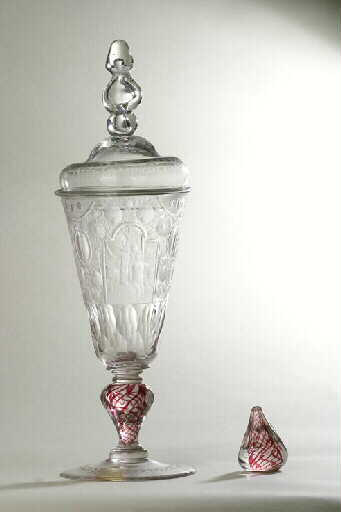
Verre haut évasé en cristal incolore, muni d'un couvercle convexe à bouton conique orné de filigranes rouges, porté par une jambe courte à noeud semblable à la prise et un pied plat, à décor taillé et gravé célébrant l'amour partagé. Le bouton est désolidarisé du couvercle. Notre pièce ressemble fortement au hanap n° 24771 du musée des Arts Décoratifs de Paris, daté du XVIIIe siècle. Un pied plat soutient une jambe courte constituée à la base d'un petit renflement supportant un noeud imposant, dans lequel sont emprisonnés des filigranes de verre rouge, surmonté de trois disques. Un couvercle convexe à bouton triangulaire semblable au noeud de la jambe s'emboîte sur le verre haut évasé. Deux guirlandes de fleurs, semblables à celles de la pièce n° 2005-0-23 de notre collection, échappées des saynètes, serpentent sur les deux tiers supérieurs du verre entre de petits cercles polis, des formes ovales plus importantes et des demi-cercles près du col. Deux rangées d'alvéoles taillées décorent en revanche la partie basse. Trois compartiments abritent chacun une séquence appartenant, semble-t-il, à un récit continu. Un personnage, muni d'un carquois dans le dos et tenant un arc, que nous pouvons identifier comme étant Cupidon, dont on aperçoit le reflet, paraît s'exercer à offrir son coeur devant un miroir entouré de fleurs. Dans la scène suivante, il le présente à un personnage dont on ne voit que le bras tendu pour le saisir, tandis qu'il reçoit ensuite d'une main celui de sa bien-aimée invisible et entoure de l'autre, un autel dédié à l'amour. Cette déclaration d'amour réciproque a certainement été réalisée à l'occasion d'un mariage. Le gobelet n° K.O.G. 204 du Rijksmuseum d'Amsterdam montre un décor d'inspiration semblable, mettant en présence le dieu de l'Amour et sa future. Une guirlande de feuilles s'enroule autour du pied et sur le bord du couvercle, sous la frise de cercles polis, tandis qu'une autre serpente sur le couvercle. (Petit, 2005)
Subject depicted
scène (allégorie, amour, Eros, carquois, coeur, miroir, guirlande orn, fleur orn)
About this work
The artwork titled "This artwork", attributed to anonyme, is preserved at musée des beaux-arts. This piece is listed in the Joconde database of the Ministry of Culture, which catalogues the works held in French museums.
Technique and Materials
This work belongs to the field: verrerie. It was created using the following materials and techniques: cristal, taillé, gravé, filigrané. Its period of creation is identified as: 18th Century.
The Conserving Museum
musée des beaux-arts preserves this work in its collections. As a « Musée de France » labeled museum, the institution is committed to preserving and showcasing the pieces entrusted to it.
Data sources
The information about this work comes from the Joconde database of the Ministry of Culture, published on data.culture.gouv.fr under the Open License v2.0 (Etalab).
About this artwork
anonyme a utilisé ici cristal, taillé, gravé, filigrané. Cette pièce mesure H. (avec couvercle) 29.5 ; H. sans couvercle 19 ; H. (couvercle) 12 ; D. du col 8.5 ; D. du pied 9.1. L'oeuvre représente : scène (allégorie, amour, Eros, carquois, coeur, miroir, guirlande orn, fleur orn). Elle est datée de la 18e siècle.
Creation context
anonyme conçoit dans un environnement artistique façonné par la 18e siècle. Cette pièce, conservée au musée des beaux-arts, porte l'empreinte des débats esthétiques et des innovations techniques qui animent alors la scène culturelle. Comprendre ce contexte permet d'apprécier pleinement la portée de l'œuvre.
See also
Technique
Domain
Author
Artistic movements
Frequently Asked Questions
Everything you need to know
The work « Untitled work » is held at musée des beaux-arts, an institution labeled as a « Musée de France ». This label guarantees the quality of collection preservation and accessibility to the public.
This artwork is attributed to anonyme according to the Joconde database of the Ministry of Culture. Check the artist's profile on DellArte to discover their background, other works, and museums that house their creations.
Data comes from the Joconde database of the Ministry of Culture (data.culture.gouv.fr), distributed under Open License v2.0 (Etalab). The records are provided by the museums and validated by the French Museum Service.
The work is part of the collections of a « Musée de France »-labelled museum. Contact the hosting museum to verify if the work is currently on display or held in reserve. Opening hours and admission fees are available on the museum's official website.
Image usage rights depend on the work, the artist, and the museum. If the author died more than 70 years ago, the work is in the public domain in France. Text data (title, technique, dimensions) are under Open License and freely reusable.
The work's record contains information from the Joconde database: title, author, technique and materials used, dimensions, creation period, artistic domain, inventory number, hosting museum, and when available, a digital image.
Use the DellArte contact page to report errors. Since data comes from the Joconde database, major corrections (attribution, dating, technique) should be reported to the Ministry of Culture via data.culture.gouv.fr.
The Joconde database lists over 700,000 works. Use the search bar to find works by the same artist, technique, or period. Each museum entry provides access to its entire digitized collection.
The image resolution depends on the museum's digitization program. Some museums offer high-resolution images through their own digital platforms. The image displayed on DellArte comes from the Joconde database at its dissemination resolution.
Museum shops often sell reproductions of their main works (postcards, posters, art books). For public domain works, services like RMN-Grand Palais (photo.rmn.fr) offer professional photographic reproductions.