Untitled work
School : France
Description
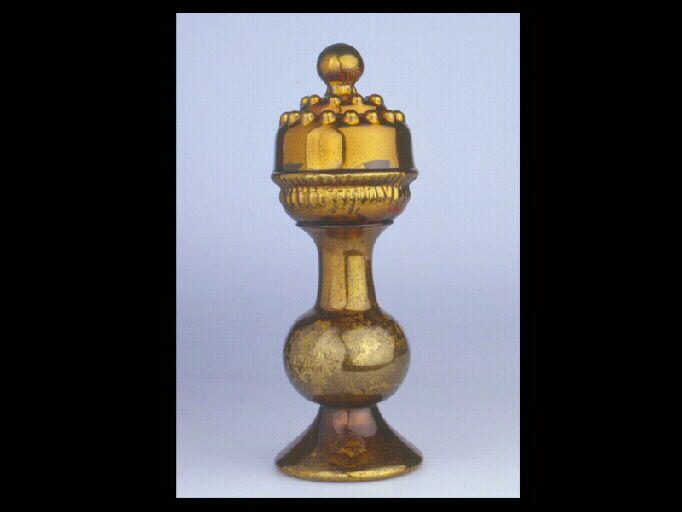
Vase à boule en verre translucide jaune étamé à l'intérieur composé de deux parties. Une longue tige portant le couvercle en forme de dôme plonge dans le vase. Un important renflement surmonte le pied en entonnoir. Le couvercle à gouttelettes repose sur un col largement évasé. La forme de l'objet semble parfaitement inadaptée à un usage de chauffe-mains, auquel il a été assimilé dans le catalogue de la collection Anthelme et Edma Trimolet. En revanche, malgré les libertés de matière, de forme et de décor prises par le verrier, en comparaison des modèles habituels, il appartient plus vraisemblablement à la catégorie des vases à boules, aussi appelés porte-perruques. Un pied plat supporte généralement une courte jambe soutenant un vase ovoïde, dont le col accueille une boule ronde et lisse (Saumur, château-musée, n° indéterminé - Paris, musée des Arts Décoratifs, n° indéterminé - p. 80). Le verre opalin reçoit un décor émaillé polychrome. Les volumes de la boule et du vase accentuent les reflets mordorés de la surface, créés par l'étamage. Une boule surmonte la partie conique du couvercle, orné de deux rangées de gouttelettes de verre, qui retombent sur de hauts bords droits. Un fin rebord et un renflement effilé font la liaison avec le col du vase. Le pied de notre pièce est ménagé dans le corps du vase. La production exclusivement française débute à la fin du XVIIe siècle, mais le nôtre date plus certainement du début du XVIIIe siècle. L'emploi du verre jaune le rattache aux créations des suiveurs de Bernard Perrot. (Petit, 2005)
About this work
The artwork titled "This artwork", attributed to anonyme;PERROT Bernard (suite de), is preserved at musée des beaux-arts. This piece is listed in the Joconde database of the Ministry of Culture, which catalogues the works held in French museums.
Technique and Materials
This work belongs to the field: verrerie. It was created using the following materials and techniques: verre (translucide, jaune), émail sur verre, polychrome. Its period of creation is identified as: 18th Century.
The Conserving Museum
"This artwork" is preserved at musée des beaux-arts, an institution bearing the « Musée de France » label. This label ensures that the collections are managed rigorously in terms of conservation, inventory, and public accessibility.
Data sources
The information about this work comes from the Joconde database of the Ministry of Culture, published on data.culture.gouv.fr under the Open License v2.0 (Etalab).
About this artwork
L'oeuvre a été exécutée en verre (translucide, jaune), émail sur verre, polychrome. Dimensions de l'oeuvre : H. 21 ; D. du pied 7.3 ; H. (partie inférieure) 12.5. Sa période de création est la 18e siècle.
Creation context
Dans quel contexte anonyme;PERROT Bernard (suite de) a-t-il créé ? La 18e siècle constitue un moment de profonde effervescence créatrice, qui nourrit et stimule la démarche de l'artiste. Le musée des beaux-arts, qui détient cette œuvre, permet au visiteur de comprendre les liens qui unissent la création artistique aux circonstances historiques de son émergence.
See also
Domain
Artistic movements
Frequently Asked Questions
Everything you need to know
The work « Untitled work » is held at musée des beaux-arts, an institution labeled as a « Musée de France ». This label guarantees the quality of collection preservation and accessibility to the public.
This artwork is attributed to anonyme;PERROT Bernard (suite de) according to the Joconde database of the Ministry of Culture. Check the artist's profile on DellArte to discover their background, other works, and museums that house their creations.
Data comes from the Joconde database of the Ministry of Culture (data.culture.gouv.fr), distributed under Open License v2.0 (Etalab). The records are provided by the museums and validated by the French Museum Service.
The work is part of the collections of a « Musée de France »-labelled museum. Contact the hosting museum to verify if the work is currently on display or held in reserve. Opening hours and admission fees are available on the museum's official website.
Image usage rights depend on the work, the artist, and the museum. If the author died more than 70 years ago, the work is in the public domain in France. Text data (title, technique, dimensions) are under Open License and freely reusable.
The work's record contains information from the Joconde database: title, author, technique and materials used, dimensions, creation period, artistic domain, inventory number, hosting museum, and when available, a digital image.
Use the DellArte contact page to report errors. Since data comes from the Joconde database, major corrections (attribution, dating, technique) should be reported to the Ministry of Culture via data.culture.gouv.fr.
The Joconde database lists over 700,000 works. Use the search bar to find works by the same artist, technique, or period. Each museum entry provides access to its entire digitized collection.
The image resolution depends on the museum's digitization program. Some museums offer high-resolution images through their own digital platforms. The image displayed on DellArte comes from the Joconde database at its dissemination resolution.
Museum shops often sell reproductions of their main works (postcards, posters, art books). For public domain works, services like RMN-Grand Palais (photo.rmn.fr) offer professional photographic reproductions.