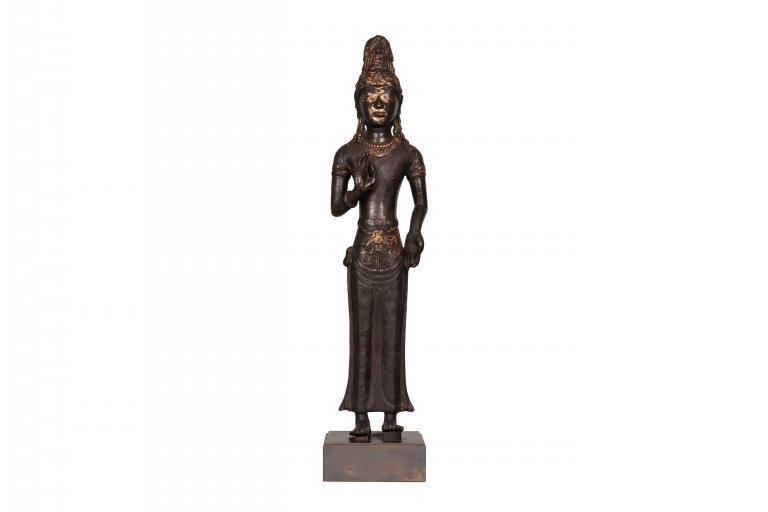
Bodhisattva Guanyin victorieux
Description
Le Bodhisattva Avalokitesvara - Guanyin est représenté debout dans une posture frontale. Sa silhouette est élancée, son torse est laissé nu à l'exception d'une parure qu'il porte autour du cou. Ses bras sont ornés de plusieurs bracelets au niveau des poignets (des rosaires, représentation typique du Yunnan) et sous les épaules. Il porte une longue jupe dothi nouée sur le devant et tombant en larges plis parallèles, ce vêtement moulant suggère les longues et fines jambes du personnage. Une ceinture à motifs floraux ceint sa taille fine.#Le visage du Bodhisattva est très dessiné avec un nez fort, des yeux mi-clos et des lèvres épaisses. Son front est marqué de l'urna et surmonté d'un couronne à trois feuilles. Ses cheveux sont rassemblés en chignon (jatamukata) et retombent en longues boucles sur les épaules. Ses oreilles portent de lourdes boucles. Son chignon est ornée du Bouddha Amitabha.#Sa main droite est levée en vitarka mudra (signe du raisonnement, de la pensée) tandis que sa main gauche est abaissée en varada mudra (geste de charité et du don).#Technique de la fonte à la cire perdue (procédé de moulage de précision, pour obtenir une sculpture en métal, à partir d'un modèle en cire) pour modeler la statuette, puis dorure. Des mortaises sont présentes à l'arrière de la statuette au niveau de la partie supérieure de son dos et de la partie supérieur de sa jupe.#Compte rendu d'étude du C2RMF disponible dans le dossier d'oeuvre.
Subject depicted
bodhisattva,Guanyin,Amitâbha,Bouddha,vitarkamudrâ,Avalokitesvara
About this work
The artwork titled "Bodhisattva Guanyin victorieux", attributed to anonyme, is preserved at musée départemental des arts asiatiques. This piece is listed in the Joconde database of the Ministry of Culture, which catalogues the works held in French museums.
Technique and Materials
This work belongs to the field: sculpture, métallurgie, croyances - coutumes, Asie orientale. It was created using the following materials and techniques: bronze (fonte, dorure). Its period of creation is identified as: 11th Century;12th Century;13th Century.
The Conserving Museum
"Bodhisattva Guanyin victorieux" is preserved at musée départemental des arts asiatiques, an institution bearing the « Musée de France » label. This label ensures that the collections are managed rigorously in terms of conservation, inventory, and public accessibility.
Data sources
The information about this work comes from the Joconde database of the Ministry of Culture, published on data.culture.gouv.fr under the Open License v2.0 (Etalab).
About this artwork
Bodhisattva Guanyin victorieux est une oeuvre de sculpture, métallurgie, croyances - coutumes, Asie orientale par anonyme, visible au musée départemental des arts asiatiques. Elle est réalisée avec la technique suivante : bronze (fonte, dorure). Dimensions : Hauteur : 47 cm ; Largeur : 13 cm ; Profondeur : 6 cm. Le sujet représenté est : bodhisattva,Guanyin,Amitâbha,Bouddha,vitarkamudrâ,Avalokitesvara. Cette réalisation date de la 11e siècle;12e siècle;13e siècle.
Creation context
Bodhisattva Guanyin victorieux prend forme dans l'atelier de anonyme en pleine 11e siècle;12e siècle;13e siècle, à un moment où les artistes redéfinissent les frontières de leur art. Les circonstances de sa création, profondément liées à son époque, confèrent à cette œuvre du musée départemental des arts asiatiques une résonance historique considérable qui dépasse le cadre purement esthétique.
See also
Technique
Author
Related pages
Frequently Asked Questions
Everything you need to know
The work « Bodhisattva Guanyin victorieux » is held at musée départemental des arts asiatiques, an institution labeled as a « Musée de France ». This label guarantees the quality of collection preservation and accessibility to the public.
This artwork is attributed to anonyme according to the Joconde database of the Ministry of Culture. Check the artist's profile on DellArte to discover their background, other works, and museums that house their creations.
Data comes from the Joconde database of the Ministry of Culture (data.culture.gouv.fr), distributed under Open License v2.0 (Etalab). The records are provided by the museums and validated by the French Museum Service.
The work is part of the collections of a « Musée de France »-labelled museum. Contact the hosting museum to verify if the work is currently on display or held in reserve. Opening hours and admission fees are available on the museum's official website.
Image usage rights depend on the work, the artist, and the museum. If the author died more than 70 years ago, the work is in the public domain in France. Text data (title, technique, dimensions) are under Open License and freely reusable.
The work's record contains information from the Joconde database: title, author, technique and materials used, dimensions, creation period, artistic domain, inventory number, hosting museum, and when available, a digital image.
Use the DellArte contact page to report errors. Since data comes from the Joconde database, major corrections (attribution, dating, technique) should be reported to the Ministry of Culture via data.culture.gouv.fr.
The Joconde database lists over 700,000 works. Use the search bar to find works by the same artist, technique, or period. Each museum entry provides access to its entire digitized collection.
The image resolution depends on the museum's digitization program. Some museums offer high-resolution images through their own digital platforms. The image displayed on DellArte comes from the Joconde database at its dissemination resolution.
Museum shops often sell reproductions of their main works (postcards, posters, art books). For public domain works, services like RMN-Grand Palais (photo.rmn.fr) offer professional photographic reproductions.